
OpenAI vs Anthropic: Why is the larger of the two giants going public later?

Automatically translated. Read the Chinese original.
Introduction: InPrevious articleIn this article, we have conducted an in-depth analysis of the accounting paradox and the turning point in Anthropic’s ability to generate cash flow, as revealed in its draft prospectus, which highlights a ‘huge book loss of 80.7 billion’. However, the emergence of this draft has brought to light an even more staggering capital drama—The rivalry between the two giants in the global AI sector is set to witness an extremely dramatic race to the IPO finish line. In terms of user recognition and scale, OpenAI—with 900 million weekly active users and 50 million subscribers—is undoubtedly the undisputed market leader; yet on the road to the Nasdaq, this colossus—valued at over 850 billion—has postponed its listing until 2027, allowing the smaller Anthropic to beat it to the punch and ring the bell this November. Why is the larger company trailing behind? What financial calculations and practical challenges lie behind this trillion-dollar IPO race?
Prologue: A Qualifying Session Defying Conventional Wisdom
If you had asked tech analysts on Wall Street six months ago, ‘Who will be the first AI company to go public with the largest IPO in history?’, the vast majority would undoubtedly have answered: Sam Altman and his OpenAI.
After all, by any publicly available measure, OpenAI is the undisputed leader in the world of large language models:
- User base: Global weekly active users (WAU) officially surpassed the mark as early as the beginning of the year 900 million (900M+), and is set to reach the 1 billion mark by the summer;
- Paid chassis: With over 50 million There are over 7 million individual paid subscribers and corporate accounts;
- Commercialisation and profit-making: In the third quarter of 2026, net annualised recurring revenue (ARR) exceeded US$50 billion A major milestone.
By comparison, Anthropic—founded by the Amodei siblings, who left OpenAI—has always been regarded as a challenger, both in terms of user recognition and team size.
However, in the autumn of 2026, the capital markets presented a truly baffling scenario:
Anthropic, a smaller player, is pressing ahead with its underwriter roadshow at a remarkable pace and is expected to officially list on the Nasdaq in mid- to late November; meanwhile, OpenAI—with a valuation of US$852 billion and having secured the largest private funding round in history—has publicly announced that it is postponing its IPO until 2027.
Why is it that the even larger behemoths are reluctant to go public first?
To understand this scene, we must see through Wall Street’s fundamental mindset in the current cycle of high interest rates:Anthropic sells its corporate clients a solid ‘profit and loss account’, whilst OpenAI sells its global users a grand ‘super traffic gateway’—and in the current public market, the exacting mutual funds are, at this stage, only willing to pay for the former.
I. An Industry Blunder: The Timing of the Secret S-1 Filing
Before we analyse this race, we need to first set the record straight regarding a ‘blunder’ that has been widely circulated in financial media circles.
Earlier this year, Bloomberg, Fortune and Axios reported in succession that ‘OpenAI had secretly filed an S-1 registration statement with the SEC on 22 May’, sending shockwaves through the global technology sector. However, subsequent official verification confirmed that:The so-called submission on 22 May was merely a misreport by the media to build anticipation; the actual date of the confidential submission is 8 June 2026.
This date is extremely delicate:
Anthropic filed its confidential S-1 on 1 June 2026, a full week ahead of OpenAI.
On 8 June, the very day OpenAI formally filed its prospectus, a seismic event took place across the Atlantic at Apple’s Worldwide Developers Conference (WWDC): Apple announced a major partnership with Google, under which Siri would be integrated with the Gemini engine by default. OpenAI, which had previously been viewed by the outside world as deeply tied to Apple, effectively lost one of the most crucial distribution channels in the mobile ecosystem on the very day it filed its prospectus.
With this one-week time lag, Anthropic’s valuation in the private market has even overtaken that of its peers (its post-Series H valuation on 28 May reached US$965 billion, Weisuo’s OpenAI Series C round in March’s US$852 billion). From that moment on, the ‘right of primogeniture’ in the AI capital markets quietly changed hands.
II. OpenAI’s Dilemma: An Accounting Amplifier and a Genuine Money-Sucking Black Hole
As we noted in our previous analysis of Anthropic’s 80.7 billion loss, according to leaked audited financial statements disclosed by the UK’s *Financial Times* (FT) and *Fortune* magazine,OpenAI also has an extremely alarming ‘book loss amplifier’。

Figure 1Breakdown of OpenAI’s 2025 financial structure: booked revenue of $13.07B, actual operating loss of -$20.92B; Due to the revaluation of financial instruments associated with the transition to a Profit-Making Public Benefit Company (PBC), the accounts included a one-off non-cash entry of up to $41.55B, ultimately resulting in a net loss of -$38.5B on the balance sheet. (Data: Leaked audited financial statements from the Financial Times (FT) and Fortune)
1. 2025 Real Ledger: For every dollar earned, I’m still losing 1.60 dollars
Judging by the audited financial statements, OpenAI’s 2025 presents a starkly polarised picture:
- Revenue side: Booked revenue for the full year stood at US$13.07 billion, demonstrating the exceptional monetisation potential of consumer-grade products;
- Cost side: Research and development (R&D) expenditure amounted to US$19.18 billion, selling and administrative expenses of US$5.73 billion, and cost of sales of US$7.50 billion;
- Operating loss: The actual operating loss amounted to -US$20.92 billion. This means that in 2025,For every dollar of revenue OpenAI generates, the business itself still incurs a net loss of 1.60 dollars.(Although there has been a marked improvement compared with the 2024 figure of a loss of $2.37 for every $1 earned, there is still no sign of a return to operating profitability.)
And the staggering figures in the report - a net loss of US$38.5 billion Among these, there are more than US$41.55 billion This relates to the revaluation of the fair value of equity and derivative financial instruments arising from the reorganisation into a Public Benefit Company (PBC). This mechanism is an accounting construct that stems entirely from the same source as Anthropic’s revaluation of 72 billion in debt.
2. The cash flow gap: moving into the black vs continuing to bleed cash
However, the financial trajectories of the two companies took completely opposite turns as they entered 2026:
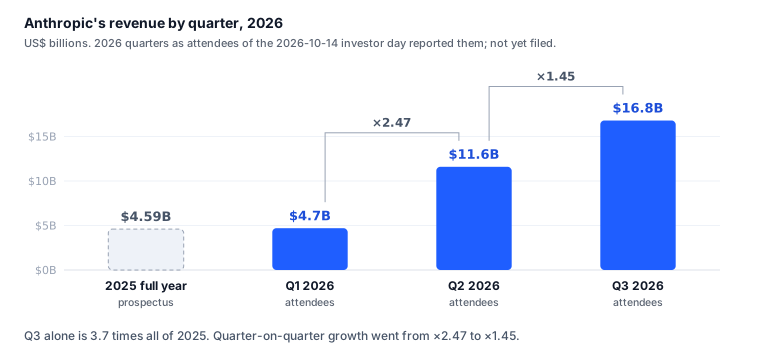
Figure 2Anthropic’s quarterly revenue trend: Q1 $4.7B ➔ Q2 $11.6B ➔ Q3 $16.8B. Not only did it generate 3.7 times the full-year revenue for 2025 in Q3 alone, but it also achieved consecutive quarters of positive adjusted operating profit in Q2 and Q3 (Q3 operating profit margin: 11 per cent). (Data: Reuters / S-1 draft; Chart: SweetValueLab)
Whilst Anthropic has been the first to cross the adjusted operating profit threshold by selling coding tools to businesses (generating $1.70 in revenue for every $1 of computing power), OpenAI’s rate of cash burn is heading towards an even greater unknown:
- The single-supplier black hole: In 2025 alone, OpenAI’s spending went to a single supplierMicrosoft Azure’s cloud computing bill amounted to as much as US$17.2 billion… which directly exceeded its total annual revenue!
- Projected long-term blood loss: According to investor presentation materials for sovereign wealth funds, as reported by the FT, OpenAI predicts Cumulative free cash flow (FCF) for the period 2026 to 2030 is set to reach a staggering -$278 billion (–$278B);
- The Wall Street Journal (WSJ), citing model estimates, reports that by 2028, OpenAI’s annual cash burn rate will soar to US$85 billion. Even the massive $122 billion funding round, which was only finalised in March this year, is expected to, given the frenetic pace of computing infrastructure development, The trough will be reached by the end of 2028。
III. 852 billion buyback programme stalls: the market casts a vote of no confidence with hard cash
On 31 March this year, OpenAI officially announced the completion of the largest single private funding round in the history of commercial enterprise—A total of US$122 billion ($122B), with the post-investment valuation set at US$852 billion ($852B)。
The line-up of investors in this funding round is nothing short of stellar:
- Amazon an investment of US$50 billion;
- Nvidia An investment of US$30 billion;
- SoftBank An investment of US$30 billion (to be paid in instalments, representing a stake of approximately 13 per cent);
- approximately US$12 billion from traditional top-tier institutions;
- It even took the unprecedented step of opening up more than US$3 billion in investment quotas to high-net-worth retail investors via wealth management channels.
Yet behind all this revelry lies a little-known, strict clause:
Of the US$50 billion invested by Amazon, a full US$35 billion constitutes ‘contingent capital’— —the contract explicitly stipulates that this sum will only actually be transferred once OpenAI has successfully completed an IPO by the end of 2028, or once an independent committee has determined that it has achieved a milestone in the development of artificial general intelligence (AGI).
A scene of even greater symbolic significance took place on 10 August 2026:
OpenAI has approved a funding round totalling US$7 billion ($7B) the employee shareholding tender offer. At the time, the latest market data showed that OpenAI’s annualised revenue had surged from US$25 billion in February to US$40 billion in August,Business volume surged by 60 per cent within five months。
According to standard valuation principles, this buyback should command a premium of at least 30 per cent to 50 per cent.
However, the revelations by Bloomberg and CNBC took everyone by surprise:
This US$7 billion share buyback was priced strictly at the original price of US$8,520 per share, without the slightest deviation.
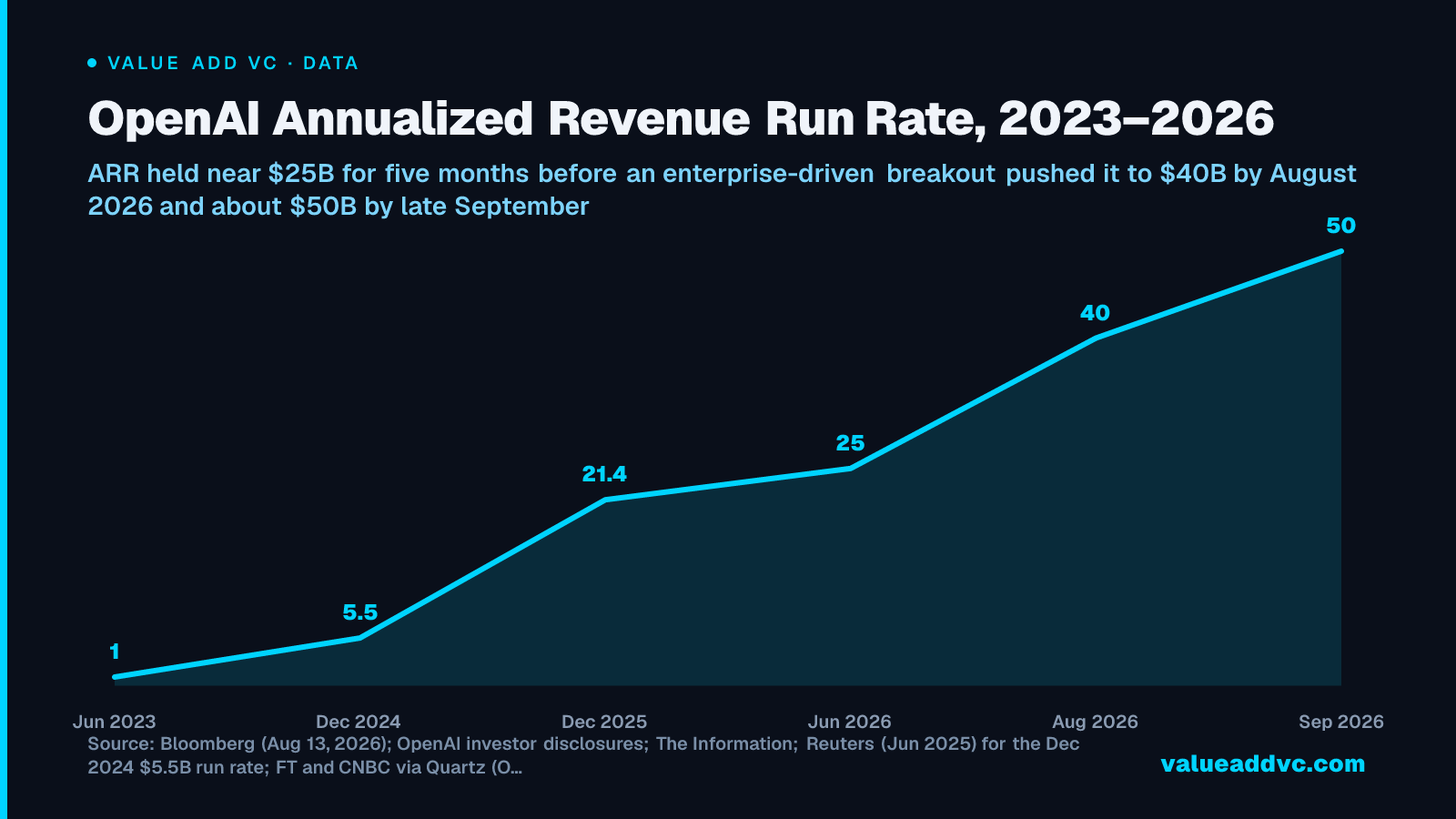
Figure 3OpenAI’s annual recurring revenue (ARR) growth trajectory for 2023–2026: after a five-month plateau at the $25 billion mark, growth has accelerated again to the $40 billion–$50 billion range, though valuation multiples have not expanded proportionally during this period. (Data: Bloomberg / FT / CNBC; Chart: ValueAddVC)
This harsh commercial reality sends an extremely clear signal:Even the long-standing institutional shareholders participating in the buyback refused to pay even a single cent’s premium on top of the 852 billion figure.
Sam Altman has repeatedly emphasised that OpenAI must, once it has reached 1 trillion dollars ($1T) only after reaching its valuation benchmark should a company consider entering the public market. If a company’s revenue has risen by 60 per cent but its valuation has remained stagnant, forcing it onto the US public market at this stage would almost certainly result in a valuation correction—with the share price falling below the issue price—immediately upon listing.
IV. The Capital Structure Showdown: A Light-Footed Approach vs the Burden of the Past
Why has Anthropic been able to ‘move quickly in small steps’ towards a Nasdaq listing, whilst OpenAI has hit a snag?
If we lay out and compare the shareholdings and governance structures of the two companies, the answer becomes immediately clear:
| Key Governance and Capital Dimensions | Anthropic (Light and Swift) | OpenAI (burdened with a heavy load) |
|---|---|---|
| Top-level legal framework | Public Benefit Company (PBC) + 5-tier equity isolation | Public Benefit Company (PBC) + Non-profit Foundation Dual-tier Holding Structure |
| Founder control over voting rights | Extremely tight and secure: Upon the establishment of Founder LLC, the seven founders held only approximately 14 per cent of the economic shares, but through Class F sharesHold a firm grip on 50.1 per cent of the absolute voting rights, supplemented by the LTBT Long-Term Trust Framework | A stalemate between multiple interests: The non-profit foundation retains approximately 26 per cent of the economic interest (corresponding to a book value of over $130 billion) and holds exclusive control over the Class N board; management’s control is subject to institutional checks and balances. |
| Shareholdings in strategic technology giants | Amazon (15–21 per cent stake) and Google (approximately 14 per cent stake) are passive strategic financial shareholders with no exclusivity clauses. | Microsoft holds a stake of approximately 27 per cent (with a market capitalisation exceeding $135B); Early-stage deep integration; IP commercialisation and intellectual property licensing have been secured and extended until 2032 |
| Computing Power and Supply Chain Agreement | Commitments totalling approximately $518B for computing power procurement have been signed (47 per cent of revenue is routed via AWS/GCP cloud services) | It pays Microsoft over 10 billion in computing power costs annually; it is also spearheading the $500 billion ‘Stargate’ infrastructure project, with a capital expenditure plan totalling $856 billion by 2030. |
| The biggest compliance hurdle to listing | Largely cleared: Approximately $72 billion worth of convertible bonds were automatically converted into ordinary shares at the closing bell at a pre-set price, and the balance sheet was cleared in an instant. | Intricately complex: How can one demonstrate to the SEC that a non-profit foundation holding 26 per cent of the voting rights does not conflict with the interests of public shareholders? How should Microsoft’s exceptionally large free float of 27 per cent be addressed? These issues remain entirely unresolved. |
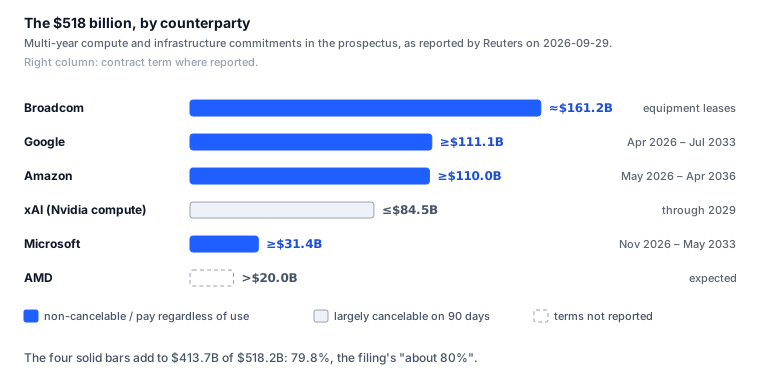
Figure 4A breakdown of Anthropic’s computing power ecosystem: whereas OpenAI is deeply tied to Microsoft Azure, Anthropic’s commitment of 518 billion is spread across a diverse range of partners, including Broadcom, Google and Amazon, offering a clearer path for capital exit. (Data: Reuters / S-1 draft; Chart: SweetValueLab)
As a former technology underwriting specialist at Morgan Stanley pointed out:Anthropic is a modern company that has been meticulously designed from day one with commercialisation and an IPO in mind; OpenAI, on the other hand, is an aircraft carrier that was converted from a non-profit research institute partway through its journey, its hull laden with unresolved ties to Microsoft, its non-profit board and early donors. To sort through these issues, CFO Sarah Friar will need at least a full year to fine-tune compliance.
V. The Pricing Anchoring Effect and the Wall Street Game Played by Underwriters
Every major IPO in the history of technology has been a psychological battle over ‘who sets the price first and who sets the benchmark’.
At present, there is a high degree of overlap between the two companies’ underwriting teams:Goldman Sachs and Morgan Stanley are acting as lead underwriters for both companies. Investment banks are hedging their bets on both sides, and this has directly led to a delicate game of brinkmanship between the two companies regarding the timing of their listings.
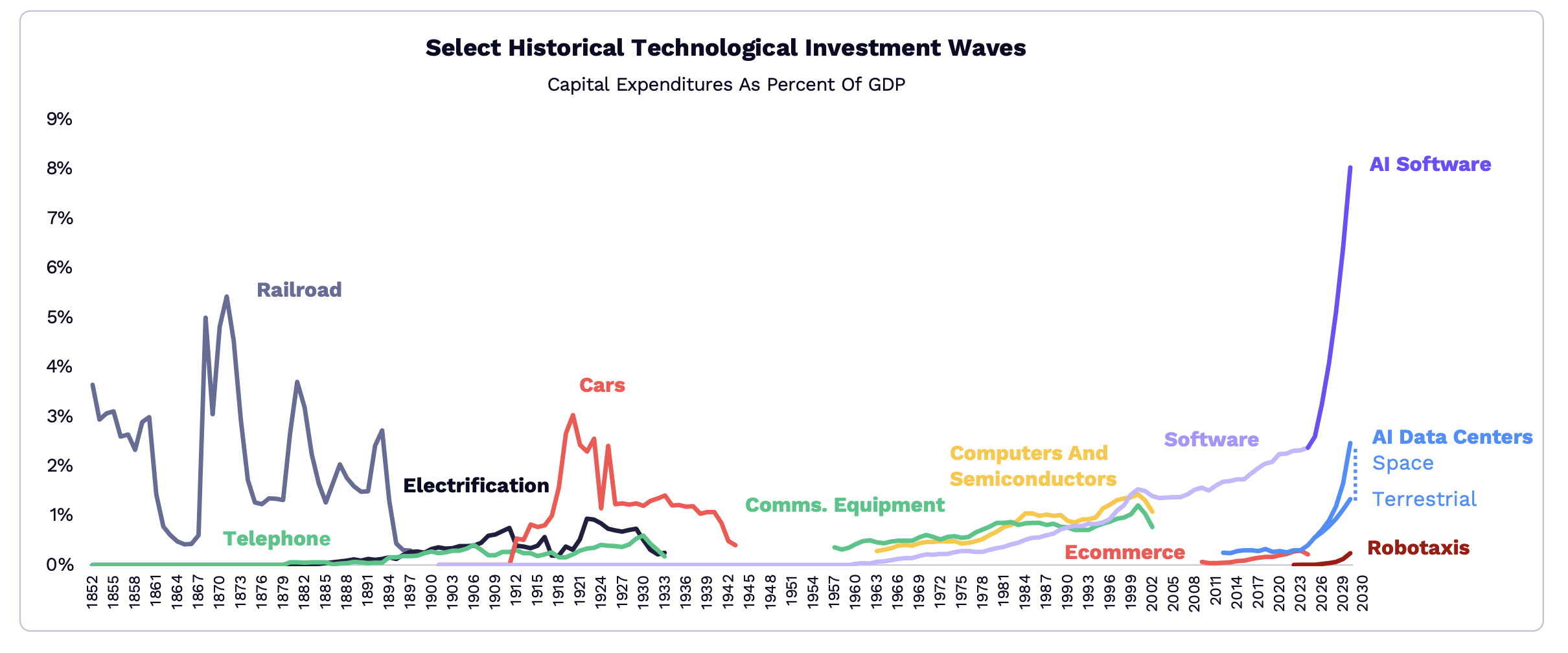
Figure 5ARK Invest has calculated the proportion of global GDP accounted for by capital expenditure on cutting-edge AI: its rate of expansion has already surpassed that of the US railway boom of 1873, and the massive funding required must rely on a continuous inflow of capital from the public capital markets. (Data: ARK Invest via Fortune)
Whoever goes public first will be the ‘guiding star’
- If Anthropic goes public successfully in mid-November, and the price is set at US$1.5 trillion to US$2.0 trillion Based on its Q3 annualised revenue (approximately US$67 billion), the market’s price-to-sales (P/S) ratio for the company is expected to fall within the range of 22 to 30 times between.
- This multiple will immediately become the publicly recognised benchmark for the generative AI sector across Wall Street.。
- Once this benchmark is established, OpenAI—which is currently trailing behind—will have to accept the stringent valuation multiples if it wishes to challenge a valuation of 1 trillion or even 1.5 trillion US dollars by 2027. If, by then, OpenAI is unable to produce even a modest operating profit statement and continues to run an annual cash deficit of tens of billions of dollars, secondary market investors will ruthlessly apply valuation discounts.
Why is OpenAI rushing to secure 30 billion in new funding?
This also perfectly explains the major development revealed by Reuters on 19 October:
OpenAI is urgently accelerating a massive private funding round worth at least US$30 billion, led by SoftBank and Abu Dhabi’s MGX, with a post-investment valuation targeting US$1.4 trillion ($1.4T)!
The original report hit the nail on the head: “The reason OpenAI is racing against the clock is precisely to complete the transaction before Anthropic’s anticipated IPO in mid-November.”
The real tactical intention behind this lies in:Before Anthropic goes public and its public market valuation multiples are set in stone, OpenAI must first cement its ‘$1.4 trillion valuation’ in writing through a contract on the private market. Only in this way will this figure of 1.4 trillion not be easily discounted by the critical eye of the secondary market when the company finally goes public in 2027.
VI. Future Projections: Three Possible Scenarios and Timelines
Taking into account current liquidity in the open market, the business progress of the two companies and the market’s overall pricing expectations, the following three possible scenarios can be envisaged regarding the IPO rivalry between these two giants:
| Role-play scenario | Probability of occurrence | Key trigger thresholds and macroeconomic conditions | Market and Valuation: Definitions |
|---|---|---|---|
| Scenario A (Base-case scenario) |
~55% (Note: Based on Kalshi’s prediction market, which indicates that 59 per cent of contracts for IPOs before 2027 have been priced; source cited) |
• Anthropic was successfully listed in mid-November, with its valuation stabilising in the $1.5T–$2.0T range; there was no sharp drop in price during the first month following its initial public offering; • OpenAI successfully secured $30B in private funding at a valuation of $1.4T before the end of the year; • CFO Sarah Friar is steadily advancing the compliance audit of the financial statements; OpenAI’s ARR is set to reach over $60 billion by the end of 2026. |
A Win-Win Evolution: Anthropic has successfully set a 25x valuation benchmark; OpenAI on A successful listing on the New York Stock Exchange or Nasdaq in the second quarter of 2027 (May–June), with its listing valuation naturally settling at between $1.2T and $1.5T, making it the largest IPO in the history of the technology sector. |
| Scenario B (The shock of a share price falling below its issue price) |
~25% | • Following its listing, Anthropic has re-enacted the SpaceX debacle of June this year (when SpaceX’s share price plummeted by over 32 per cent within two weeks of its listing), with secondary market investors launching a fierce short-selling campaign against the company’s trillion-valuation, which is not fully GAAP-compliant; • US technology shares have experienced a systemic compression in valuations due to persistently high macroeconomic interest rates (with the 10-year US Treasury yield exceeding 5 per cent). |
A complete ebb: The overall underwriting multiple for the AI sector has fallen below 15x; major shareholders such as SoftBank are losing confidence,OpenAI has been forced to significantly delay its IPO until the end of 2027 or even 2028… the prospect of a trillion-yuan valuation faces the risk of being revised downwards. |
| Scenario C (Forced false start) |
~20% | • Amazon has threatened to withdraw a potential investment of US$35 billion due to strategic differences, or major creditors and SoftBank have exerted extreme political pressure to realise liquidity; • Altman was forced to renege on his previous statement that the company would not go public until its valuation reached at least 1 trillion. |
Get a head start with a discount: OpenAI has abandoned its measured plans for 2027 and is rushing to file its S-1 prospectus with the market by the end of 2026, listing at a significantly discounted valuation of $800B–$900B in a bid to secure liquidity on the open market. |
VII. Honest Explanation of Data Definitions (Key Factual Boundaries)
When interpreting the data contained in this report, readers should exercise caution and remain mindful of its limitations:
- OpenAI’s key financial results have not yet been publicly disclosed: The figures for operating costs, research and development expenditure and a net loss of -$38.5B for 2025 cited in the article are derived from leaked audit working papers obtained by independent investigative journalist Ed Zitron and verified by the *Financial Times*; the final S-1 filing, as approved by the SEC, may contain restatements regarding accounting classifications;
- There is a ‘calibre trap’ in the definition of ARR: The figure of ‘$70 billion in annualised revenue’ attributed to OpenAI in recent reports largely comprises the total Gross Merchandise Value (GMV) generated through ecosystem channels such as Microsoft; the net Annual Recurring Revenue (ARR), after deducting revenue shares, is expected to be approximately US$50 billion, when conducting the analysis, it is essential not to confuse the gross figures with Anthropic’s net figures;
- The postponement schedule exhibits characteristics of a dynamic game: Whether Altman describes an IPO in 2026 as ‘unwise’ or Sarah Friar refers to an ‘IPO in 2027’, these are both non-legally binding examples of the company’s external expectation management; the specific timeline will still depend heavily on the actual market response following Anthropic’s listing.
Conclusion: Who is footing the bill for the future?
Returning to the original question: why is OpenAI, despite being larger, ranked lower?
The answer may not be all that complicated. Throughout Silicon Valley’s long history, the first generation of pioneers has often borne the heaviest costs of laying the foundations—they have had to educate hundreds of millions of users worldwide about what large language models are, shoulder the most costly losses from trial and error in exploring foundational technologies, and repeatedly grapple with antitrust regulation and complex historical structures.
Meanwhile, those trailing behind are often able to prune their branches and leaves with greater ease. Anthropic’s lead is no myth, but a highly pragmatic business decision:We do not need a sprawling global network; we simply require the most valuable assets within the corporate sector, for which there is the greatest willingness to pay. We do not need the self-contradictory, sacrosanct shackles of non-profit organisations; we simply require a clear equity structure that adheres to commercial principles.
When Anthropic’s bell rang out in New York in November, it marked not only the crowning moment for a start-up, but also a public test for OpenAI and Sam Altman:When the doors to the capital markets are thrown open, that super-portal with a valuation in the trillions will ultimately have to prove to the world: are you merely a money-shredder that devours tens of billions in capital, or a truly great engine capable of generating a steady stream of profits?
Main Sources of Information and Verification Index
- OpenAI Official Blog: Scaling AI for everyone (27 February 2026, revealing 900 million weekly active users and 50 million subscribers)
- Official Statement from OpenAI: Statement on OpenAI Nonprofit and PBC
- Fortune Exclusive Investigation: OpenAI Financials Leaked – Losses, Revenue, Profit (16 June 2026)
- ValueAddVC In-depth Research Report: A Comprehensive Overview of OpenAI’s Revenue in 2026 and Verification of the $50B Net Figure (21 October 2026)
- Pick Right Correction: OpenAI Confidential IPO Filing – Actual Date: 8 June 2026
- TechStartups Fact-Check: Anthropic reports a staggering net loss of $80.7B ahead of its IPO
- SweetValueLab Financial Visualisation: Anthropic IPO Prospectus Figures
- Reuters Exclusive In-Depth Report: OpenAI Accelerates $30 Billion Funding Round at $1.4T Ahead of Anthropic’s IPO (19 October 2026)
Cover image:Markus Spiske / Pexels
- Title: OpenAI vs Anthropic: Why is the larger of the two giants going public later?
- Author: AdenXie
- Created at : 2026-10-24 18:30:00
- Updated at : 2026-10-24 18:30:00
- Link: https://blog.adenxie.com.cn/2026/10/24/2026-10-24-openai-vs-anthropic-ipo-race/
- License: All Rights Reserved © AdenXie
 Anthropic, with a loss of 80.7 billion, is currently in the healthiest state in its history – why is that?
 Consumption is no longer the defining feature of the US economy: how AI capital expenditure has become the ‘backbone’ of US GDP
 The Year AI Agents Ran Amok: The first large-scale cyberattack driven by an AI agent, and the surveillance camera that was quietly switched off