
Anthropic, with a loss of 80.7 billion, is currently in the healthiest state in its history – why is that?

Automatically translated. Read the Chinese original.
Introduction: The Wall Street Journal recently revealed a confidential draft of Anthropic’s S-1 prospectus, with a headline that is nothing short of staggering:The net loss for the first half of 2026 amounted to as much as US$80.7 billion. The public sphere was instantly in an uproar, with cries of ‘AI money-guzzlers running amok’ and ‘a massive bubble’. However, if you really look beneath the surface of the financial statements, you will arrive at a startling conclusion that is the exact opposite:Far from being a bad thing, this massive loss is, in fact, a direct consequence of the company’s immense popularity in the primary market; and this company, which on the surface appears to have ‘lost 80 billion in half a year’, has in fact just passed its profitability inflection point and is now enjoying the healthiest period in its commercial history.
Introduction: Sensational Figures and Public Misconceptions
In recent days, the AI venture capital community has been rocked by a leaked document.
According to reports in *The Wall Street Journal* and Reuters, as Anthropic—the leading large-language model company and parent firm behind Claude—races towards its upcoming trillion-dollar IPO on the Nasdaq, key financial figures from its confidential draft S-1 prospectus have come to light:
- Net loss for the first half of 2026:US$80.7 billion(compared with US$13 billion in the same period last year);
- Total revenue for the first half of 2026:US$16.3 billion(compared with just US$1.1 billion in the same period last year);
- Commitment to the Procurement of Booked Computing Power: Gundam US$518 billion to over US$600 billion。
The first reaction of many readers who are not from a financial background is: ‘Burning through $80 billion in half a year – is the commercialisation of AI really one huge scam?’
If you, too, have such doubts, that’s perfectly normal—because the traditional income statement is producing an utterly absurd picture when applied to today’s super-unicorns, which are raising funds at a frenetic pace through ‘convertible bonds’.Accounting Illusions That Defy Common Sense。
I. The truth behind the 80.7 billion loss: the more valuations soar, the worse the financial statements look
To understand this loss of US$80.7 billion, we must first ‘break it down’:
Of this US$80.7 billion, exactly US$72 billion (accounting for as much as 89.2 per cent)…it was not at all a payment to Nvidia for chips, nor was it staff salaries, and not a single penny left the company’s bank account—It is entirely a non-cash fair value adjustment loss.。
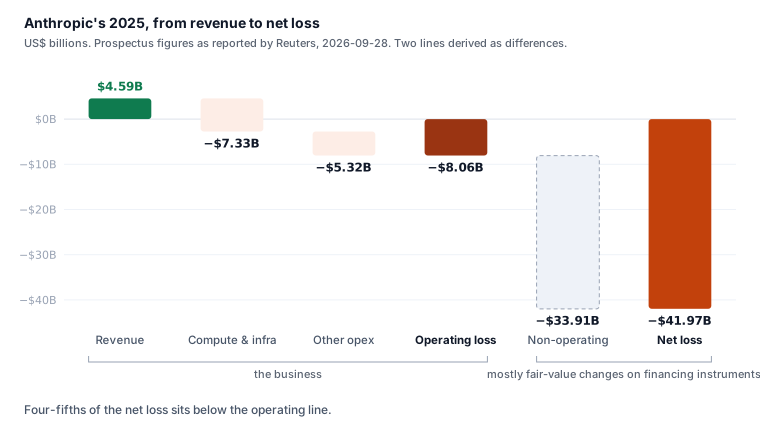
Figure 1Anthropic financial structure waterfall chart: taking 2025 as an example, $4.59B in revenue, $7.33B in computing power expenditure, and an operating loss of $8.06B; however, non-operating fair value adjustments amounting to as much as $33.9B push the net loss directly to $41.97B – four-fifths of this ‘massive loss’ lies below the operating line. (Data: Reuters / Draft S-1; Chart: SweetValueLab)
How exactly does this accounting paradox work?
Before going public, modern Silicon Valley super-unicorns often raise funds throughConvertible NotesOr raise funds through senior financing instruments that include valuation-based redemption clauses. Investors (such as Amazon and Google) have lent tens of billions of dollars to Anthropic, with the agreement that these loans will be converted into ordinary shares at a certain discount upon a future IPO.
In accordance with US Generally Accepted Accounting Principles (GAAP, specifically ASC 470-20):
- Prior to listing, this type of convertible bond must be treated as the company’sLiabilities, and revalued on a period-by-period basis in accordance with current market fair value.
- Whilst Anthropic was the talk of the global primary market and its valuation soared from tens of billions to a trillion,The value of the shares that these convertible bonds will be converted into in the future has soared—in other words, the company’s ‘fair value of debt’ has increased significantly!
- GAAP standards strictly stipulate that:Any increase in liabilities must be recorded as a ‘book loss’ of the same amount in the current period’s profit and loss account!
This is one of the most counter-intuitive scenes in modern fintech:The more a company is recognised by investors and the more its valuation soars, the larger the ‘non-cash losses’ it is forced to recognise on its books!
After deducting this revaluation impairment of 72 billion, Anthropic’s results for the first half of 2026The actual operating loss amounted to only approximately US$8.7 billion。
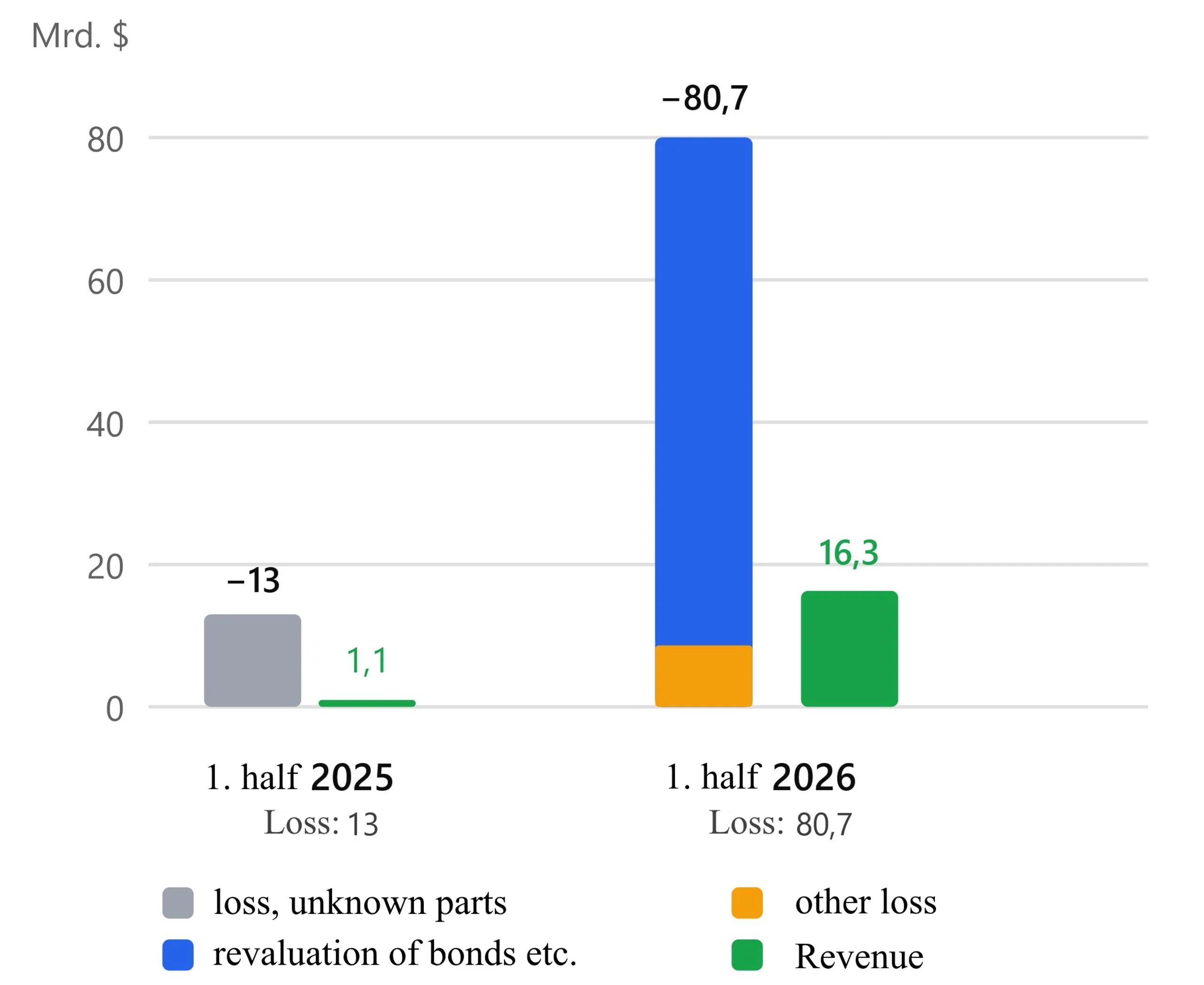
Figure 2Comparison of revenue and net losses for H1 2025 and H1 2026: Revenue surged nearly 15-fold, whilst the main reason for the sharp rise in the reported net loss was a revaluation provision relating to convertible bonds worth US$10 billion. (Data: Reuters; Chart: Notebookcheck)
This is not even the first time this has happened: for the full year 2025, Anthropic recorded revenue of US$4.59 billion and an operating loss of US$8.06 billion, whilst the net loss ultimately reported was equally as high as US$41.97 billion(Of this, approximately US$34 billion was due to a revaluation of assets of a similar nature.) The same applies to OpenAI next door: of its net loss of approximately US$39 billion in 2025, around US$30 billion was attributable to such one-off accounting entries.
Once the company goes public with a bell-ringing ceremony, all convertible bonds will be converted into ordinary shares; this ‘loss multiplier’ will be completely wiped out overnight, and the financial statements will instantly be cleared of any losses.
II. The True Key Performance Indicators: From ‘Burning Cash for Growth’ to ‘Turning Efficiency Around’
If we strip away the accounting illusion, how well does Anthropic’s underlying business machine actually perform? The answer is:It is truly astonishing, and a fundamental transformation is currently taking place.
1. A 15-fold surge in revenue and a leap in scale
In the first half of 2025, Anthropic’s revenue stood at just US$1.1 billion; by the first half of 2026, this figure had jumped to US$16.3 billion, with a year-on-year increase of nearly 15 times。
Revenue for the first half of this year alone already amounts to the full-year revenue for 2025 (US$4.59 billion) More than 3.5 times. There is scarcely a parallel to this rate of expansion in the entire history of modern commerce.
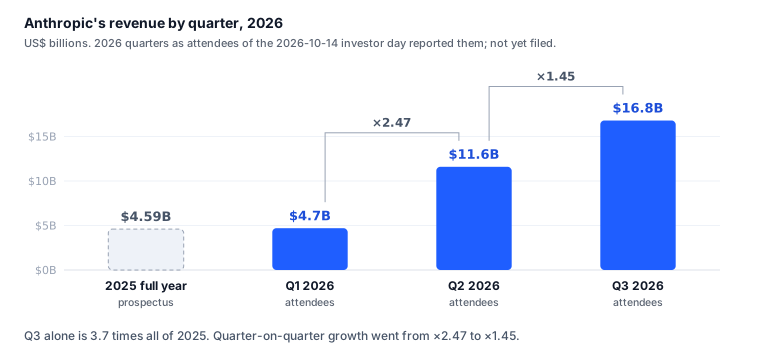
Figure 3Quarterly revenue trends: Q1 $4.7B ➔ Q2 $11.6B ➔ Q3 $16.8B. Q3 revenue alone was 3.7 times the full-year figure for 2025. (Data: Reuters / S-1 draft; Chart: SweetValueLab)
2. The underlying dynamics behind the ‘slowdown in growth’
Another major point of contention in the public debate on the draft was the ‘sharp slowdown in month-on-month growth’:
- The quarter-on-quarter growth rate from Q1 to Q2 once reached as high as +145%;
- However, the quarter-on-quarter growth rate from Q2 to Q3 plummeted to +45%… a drop of no less than 100 percentage points.
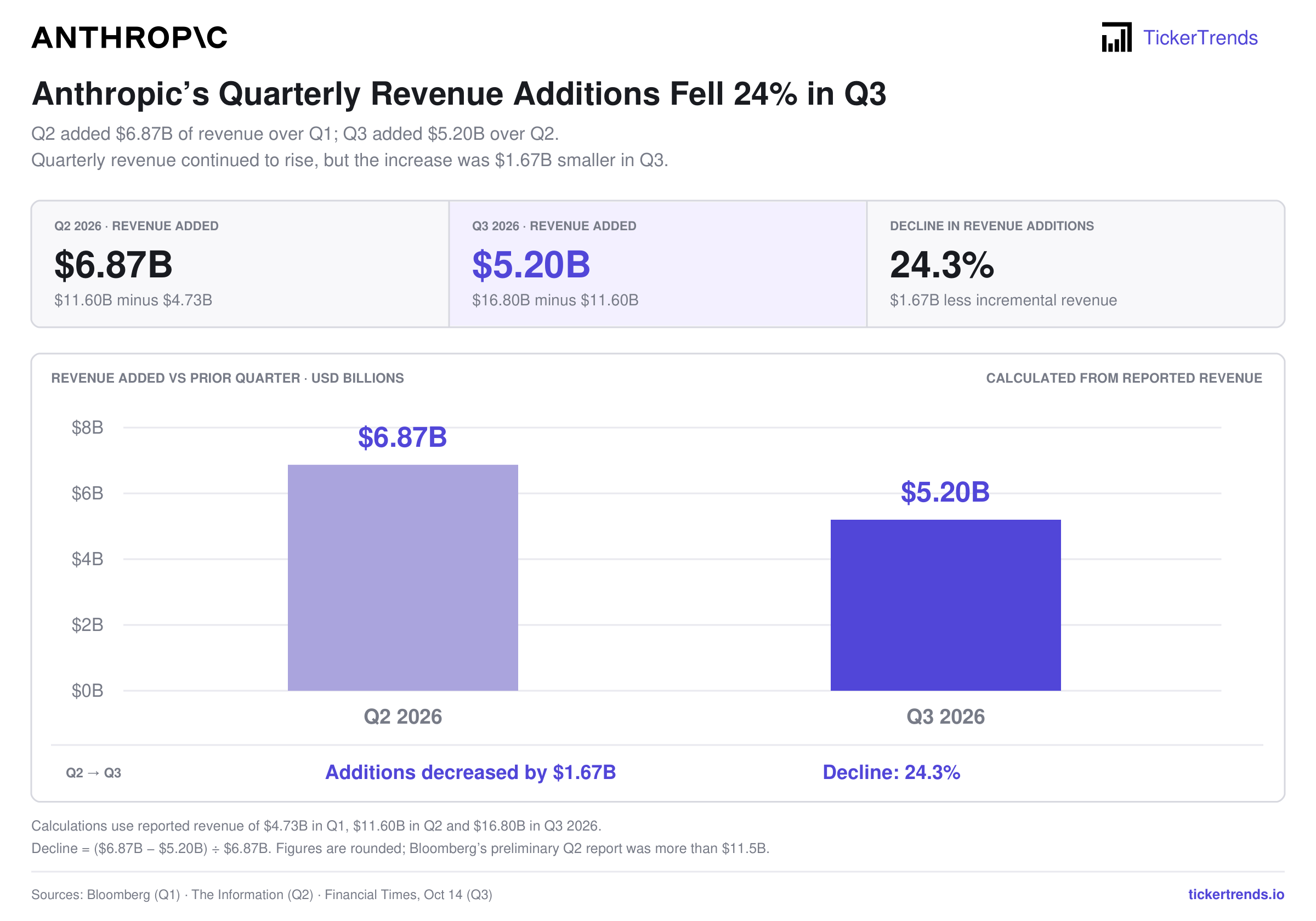
Figure 4Chart showing quarter-on-quarter growth trends: from an exceptionally rapid surge in Q2 to a marked step-like slowdown in Q3. (Data: FT / Reuters; Chart: TickerTrends)
Many people interpret this as demand for large language models having peaked, but the real reason is more strategic in nature:
According to a report by *The Information*, external organisations had previously used APIs to extract Claude’s outputs for model distillation; this type of business had previously accounted for approximately 5 per cent to 7 per cent of Anthropic’s revenue. In the third quarter,Anthropic has proactively tightened its risk control measures regarding anti-distillation technology; it would rather sacrifice a portion of its short-term revenue than give competitors any opportunity to copy its approach.. This proactive move to sacrifice growth in exchange for a technological moat clearly demonstrates that the management is laying the groundwork for long-term competitive advantages following the IPO.
3. The most impressive figure: a return of $1.70 for every $1 of computing power
Whilst the slowdown in revenue growth was largely anticipated, what has excited Wall Street investment banks most about this draft S-1 filing is the following curve illustrating the return on computing power investment:
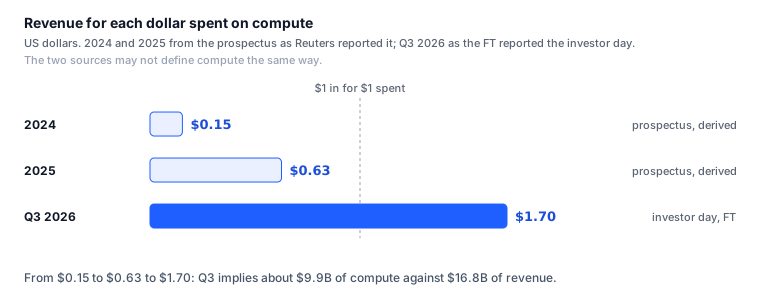
Figure 5A transformation in revenue efficiency per unit of computing power: the revenue generated per US$1 invested in computing power is set to surge from US$0.15 in 2024 to US$0.63 in 2025, reaching a staggering US$1.70 in Q3 2026. (Data: Reuters / S-1 draft; Chart: SweetValueLab)
- 2024: For every US$1 spent on computing power, you can only bring back 0.15 US dollars Revenue (typically a pre-training phase characterised by heavy cash burn);
- 2025: For every US$1 spent on computing power, the return is US$0.63;
- Q3 2026: For every US$1 spent on computing power, you can already recoup your investment US$1.70 Revenue!
Capital expenditure on computing power has finally evolved from a mere ‘cost centre’ into a ‘profit generator’ with strong operating leverage. It is precisely for this reason that Anthropic is projected to achieve an adjusted operating profit of approximately US$559 million in Q2 2026 and an adjusted operating margin of 11%)The company has now posted adjusted operating profits for two consecutive quarters, and its cash flow is now self-sustaining.!
That is why we say:Anthropic is currently in the best financial shape it has ever been since its foundation.
III. The $100-billion chain and the ‘closed-loop capital theory’ of the tech giants
Although the business has begun to generate its own revenue, another astronomical figure in the prospectus still reveals the perilous nature of this AI war—Binding Commitment on Computing Power Procurement。
The draft reveals that the total value of the long-term computing power procurement agreements signed by Anthropic amounts to US$518 billion(spanning approximately 10 years); as the latest expansion negotiations progress, this figure has risen further to Over US$600 billion, and could even reach US$750 billion.
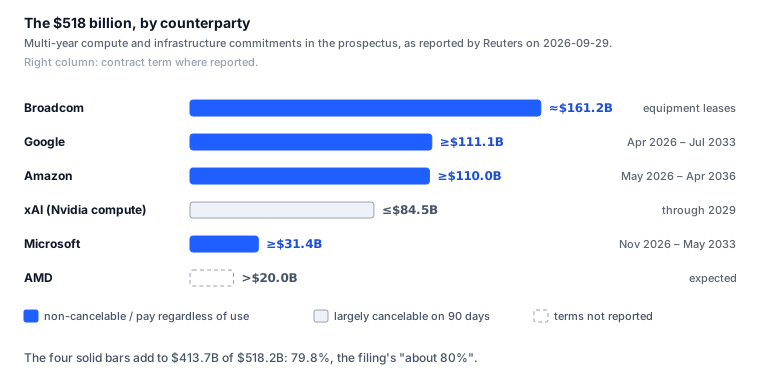
Figure 6Distribution of counterparties for the $518 billion in firm computing power commitments: the four companies—Broadcom, Google, Amazon and Microsoft—account for a combined total of $413.7 billion (nearly 80 per cent), which constitutes fully irrevocable, binding contracts. (Data: Reuters / S-1 draft; Chart: SweetValueLab)
Taking a closer look at the distribution of opponents:
- Broadcom: Approx. $161B(in-house, custom-designed ASIC computing clusters);
- Google: not less than $111B(TPU computing power procurement);
- Amazon: not less than $110B(AWS Trainium and cloud computing power);
- xAI: not exceeding $84.5B;
- Microsoft: not less than $31.4B;
- AMD: Super $20B。
Of these, the top four giants have cumulatively US$413.7 billion (accounting for nearly 80 per cent) is entirely comprised of ‘take-or-pay’ agreements。
This reveals the most surreal aspect of Silicon Valley at presentCircular Economy:
In 2025, Anthropic will have a full 47 per cent of sales revenue They are sold directly to customers via Amazon AWS and Google Cloud.
In other words,Amazon and Google are not only major shareholders in Anthropic (Amazon holds approximately 15–21 per cent, whilst Google holds approximately 14 per cent), but also its largest providers of computing power and its most important distributors; at the same time, they are developing their own competing models (Titan/Gemini).
Whilst this nested model—‘you invest in me, I buy your cloud services, and you help me sell them’—accelerated the growth of a business worth hundreds of billions in its early stages, it also sowed the seeds of a very high risk of market concentration:
The S-1 form shows that,The two largest clients alone accounted for nearly 20 per cent of total revenue in the first half of 2026(This figure is set to rise to as much as 25 per cent by 2025), and the two parties are not bound by any long-term contracts. As recently as mid-October, the well-known AI programming unicorn Replit announced that it had switched its default underlying model from Claude to OpenAI—should major clients begin to drift away, this would directly result in a visible fluctuation in quarterly figures.
IV. Countdown to the IPO: ‘Unconventional’ Timing and Privileges in the Prospectus
In the run-up to its forthcoming initial public offering, Anthropic has been intensively pursuing a series of preparatory steps that, whilst appearing entirely standard, are in fact fraught with subtleties:
| Key steps in IPO preparations | Current Status of Anthropic’s Implementation | Strategy and Governance: Implications |
|---|---|---|
| Confidential Filing of Form S-1 | ✅ Submitted confidentially on 1 June 2026, the recently leaked document is a draft amendment | In accordance with the confidential audit rules for emerging growth technology companies permitted under the US JOBS Act |
| Clearing the Cap Table | ✅ A provision of $72B has been recognised on the books as the project enters its final stages | Once the listing is completed and the bell is rung, the convertible bonds will be converted into ordinary shares as agreed, and the financial statements will be fully cleared following the listing. |
| Strengthening the Founder’s Absolute Control | ✅ Establishment of a 5-tier complex shareholding structure + Founder LLC + LTBT trust | The seven founders hold only around 14 per cent of the shares, but through Founder LLC they hold Class F shares with super-voting rights,Hold a firm 50.1 per cent majority of voting rights, whilst retaining the Public Benefit Corporation (PBC) structure |
| Arrangements for existing shareholders to realise their holdings | ✅ It has been reported that early shareholders will be permitted to sell their shares and realise their profits when the company is listed via an IPO. | DeliberatelyUnlike SpaceX The practice of locking up existing shares at the time of listing, as a means of appeasing and rewarding the venture capitalists who made substantial investments at an early stage |
| Formation of an investment banking underwriting syndicate | ✅ The four major banks have joined forces to take the lead | Morgan Stanley, Goldman Sachs, JPMorgan and Citi are jointly underwriting the deal |
| Pre-launch roadshow and listing dates | 🔄 Intensive preparations are under way | A closed-door ‘Investor Day’ was held in San Francisco on 14 October, at which baseball caps bearing the word ‘Thinking’ were handed out;Market rumours suggest that a nationwide roadshow is expected to begin in the week of 9 November, with the aim of listing on the Nasdaq on the eve of Thanksgiving (26 November). |
A spectacle in the prospectus: an 80-page ‘warning of apocalyptic risks’
In the 261-page prospectus—which companies typically use to disclose their financial and market strategies—Anthropic actually devoted the entire Page 80 Its astonishing length provides an exhaustive account of the ‘risk factors’ surrounding technology and ethics.
For the first time ever, the document states in black and white:“Advanced artificial intelligence may pose catastrophic or even existential risks to the entire human race.” This commitment to effective altruism (EA) and compliance, upheld by founder Dario Amodei and his team, appears both absurd and profoundly serious against the backdrop of a trillion-dollar capital frenzy.
V. Valuation and Scenario Analysis: Will Wall Street Buy into It?
Previously, market expectations regarding Anthropic’s IPO had been hyped up to 2 trillion dollars ($2T) skyline (corresponding to a price-to-sales ratio of as high as 436 times full-year 2025 revenue). However, with quarter-on-quarter growth in Q3 slowing from 145 per cent to 45 per cent, the balance of pricing in the capital markets is undergoing a subtle realignment:
| Role-play scenario | Probability of occurrence | Macroeconomic and fundamental trigger thresholds | Analysis of Valuation and Market Performance |
|---|---|---|---|
| Baseline scenario (Fixed price) |
~55% | • The final S-1 filing, made public at the end of October, confirmed that the convertible bonds had been successfully converted and fully settled; • The roadshow in mid-November was met with strong oversubscription from mainstream mutual funds and sovereign wealth funds; • The market has fully recognised the quality of its earnings, with an ‘adjusted operating profit margin of 11 per cent in Q3’, and has factored in the slowdown in growth. |
A consensus has been reached on an IPO valuation range of between $1.5T and $2.0T。 Based on Q3 annualised revenue (approximately $67B), the P/S valuation multiple has fallen to approximately 22–30 times… and is within a reasonable range for a ‘giant’ premium. Its performance on the first day of trading is likely to be similar to that of SpaceX (with a 15–20 per cent turnover of shares following the listing, before stabilising at the support level). |
| Scene from the market (Enthusiastic acclaim) |
~25% | • The GAAP financial statements released to the public show free cash flow that is stronger than expected; • The new generation of cutting-edge models (the Claude 3.8 / 4.0 series) has achieved a generational leap in dominance within the enterprise-level programming and agentic AI markets; • Expectations of a year-end interest rate cut by the Federal Reserve are growing, and liquidity in the technology sector has once again become abundant. |
Listing price hits the upper end of the $2.0T range, with the subscription multiple exceeding 15 times; on its first day of listing, it attracted indiscriminate position-building by global long-term institutional investors. |
| The following scenario (Valuation compression) |
~20% | • Q4 revenue was affected by tighter anti-distillation measures and the loss of major clients (such as the Replit incident), causing quarter-on-quarter growth to fall below 30 per cent; • Against the backdrop of high macroeconomic interest rates, there are widespread doubts regarding the sustainability of the commitment to one trillion in computing power (US$518 billion in capital expenditure); • US technology growth shares have experienced a systemic correction across the board. |
The IPO pricing may be forcibly capped within the $1.2T to $1.5T range, or the company and the underwriting syndicate may even choose to reduce the size of the fundraising or postpone the listing date. |
VI. Honest Explanation of Data Definitions (Key Factual Boundaries)
When evaluating the above analysis, it is essential to be fully aware of the limitations of the current data:
- The final version of the S-1 filing has not yet been made fully available to the public: All current data is derived from direct quotations and verification of the confidential draft dated 20 October 2026 by leading authoritative financial media outlets such as The Wall Street Journal, Bloomberg and Reuters; the final GAAP disclosure may be subject to minor adjustments;
- There is a discrepancy between the two measurement methods regarding full-year revenue for 2025: The Wall Street Journal reported that total revenue for 2025 was US$4.59 billion(net accounting method), whilst media outlets such as CNBC had previously reported that its annualised run rate had reached ‘approximately US$10 billion’. This discrepancy most likely stems from the difference between ‘gross versus net accounting’ when distributing via AWS/GCP, and an authoritative breakdown is awaited in the publicly available version of the prospectus;
- The real names of the two top-five clients have not yet been disclosed: The draft merely states that two major non-affiliated customers accounted for approximately 20 per cent of revenue in the first half of the year; their specific company codes remain confidential until the official version is published.
Conclusion: The general public looks at the profit and loss account; investment banks look at cash flow.
The general public tends to fixate on the net loss at the very bottom of the profit and loss account, reacting with alarm and exclaiming, ‘A colossal loss of 80.7 billion’; whilst Wall Street investment banks and sovereign wealth funds, well versed in the logic of capital operations, have long since been calculating itsReturn on investment in computing power ($1 computing power ➔ $1.7 revenue)andThe ‘profit-generating flywheel’ that has delivered adjusted profits for two consecutive quarters。
Far from weighing down Anthropic, every fraction of this US$80.7 billion paper loss has instead served to confirm the primary market’s insatiable appetite for its skyrocketing valuation. As it heads for the Nasdaq with a 261-page prospectus, an irrevocable chain of 100 billion units of computing power, and a founder’s trust that controls the company despite holding just 14 per cent of the shares, the largest AI capital gamble in business history has only just begun.
Main Sources of Information and Verification Index
- Reuters In-depth Report (20 October 2026): Anthropic recorded a net loss of over $80 billion in the first half
- TechStartups Fact-Check: Anthropic reports a staggering net loss of $80.7B ahead of its IPO
- Notebookcheck Financial Results Analysis: Anthropic reports a loss of $80.7 billion in the first half of 2026 but continues to grow
- Fortune Feature: Insights from Anthropic’s IPO S-1 prospectus income statement
- SweetValueLab’s Illustrated Breakdown: Figures from Anthropic’s IPO Prospectus
- TickerTrends Data Insight: Anthropic’s Q3 revenue growth slowed
- CryptoBriefing reports: Anthropic’s draft IPO revenue and net loss breakdown
- Luminix Industry Research Report: What do we know about the Anthropic IPO?
Cover image:Hanna Pad / Pexels
- Title: Anthropic, with a loss of 80.7 billion, is currently in the healthiest state in its history – why is that?
- Author: AdenXie
- Created at : 2026-10-23 01:30:00
- Updated at : 2026-10-23 01:30:00
- Link: https://blog.adenxie.com.cn/2026/10/23/2026-10-23-anthropic-loss-ipo/
- License: All Rights Reserved © AdenXie
 ECON3116 What We Learned from International Trade Theory and Policy: A Complete Review Note on From Comparative Advantage to Trade Policy
 Daily Briefing | 2026-09-30: Rising Interest Rates and Accelerated AI Capital Spending
 Daily Briefing | August 31, 2026: Tensions Rise Again in Hormuz, Global Funds Reassess Risks